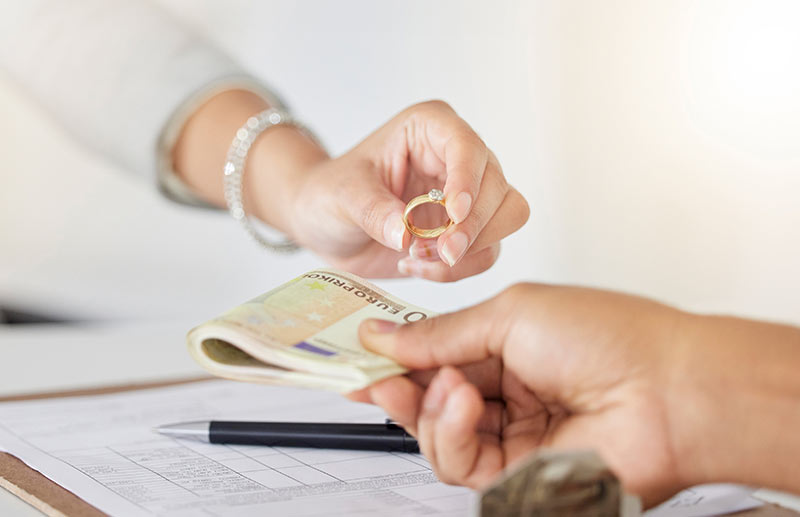
For Pawn Central (Galesburg, Macomb, Rock Island, IL — and Clinton, IA)
Silver has quietly stolen the stage in 2025. After years of being the “little brother” to gold, silver has staged a dramatic rally this year — driven by a mix of macroeconomic forces (a softer dollar, growing rate-cut expectations), safe-haven demand, and rising industrial use in electronics, solar, and electric vehicles. Spot prices and futures have already climbed into multi-year highs in September 2025, and many investors are taking notice.
If you’re a Pawn Central customer in Illinois or Iowa, this blog explains why silver is getting attention, how you can start with as little as $40 a month, and what a realistic, practical plan could look like to build a nest egg over time — all with options that tie into what pawn shops do best: buy, sell, store, and appraise physical precious metals.

1) Where silver sits right now — the market snapshot you should know
As of late September 2025, silver spot and futures prices are trading in the mid-$40s per troy ounce. Major market feeds and live charts show silver around $46–$47 per ounce during trading on September 29, 2025. Front-month futures have been quoting in the mid-$40s, and spot feeds from trusted precious-metals platforms confirm strong price gains this month.
Why the spike? The main drivers reported by market outlets are:
- A weaker U.S. dollar and growing bets on Federal Reserve rate cuts — both of which tend to make precious metals more attractive.
- Renewed safe-haven buying (investors choosing tangible assets amid economic and geopolitical uncertainty).
- Strong industrial demand for silver in electronics, photovoltaics (solar panels), and EV components — all sectors that use silver for its electrical and reflective properties.
(Short, transparent note: precious metals are volatile — even during rallies — and past performance doesn’t guarantee future results. That said, today’s price action has made silver an attractive consideration for many investors who want a tangible hedge.)
2) Why silver — not only a precious metal but an industrial metal
Silver sits in a unique spot among investment assets:
- Dual demand: Silver is both a monetary/safe-haven asset (like gold) and a critical industrial metal. That means it benefits from both investment flows and real-world manufacturing demand.
- Relatively small above-ground supply: Compared with gold, silver’s above-ground investment stock is much smaller, so large flows into investment products can be more price-sensitive. Market squeezes and shifts in demand can therefore move the price more dramatically.
- Practical sizes for small investors: Because silver is relatively inexpensive per ounce compared with gold, small recurring purchases (dollar-cost averaging) let everyday budgets buy meaningful physical ounces over time.
These attributes make silver particularly appropriate for dollar-cost averaging — buying a set dollar amount on a regular schedule — which is exactly what a $40-per-month plan is.
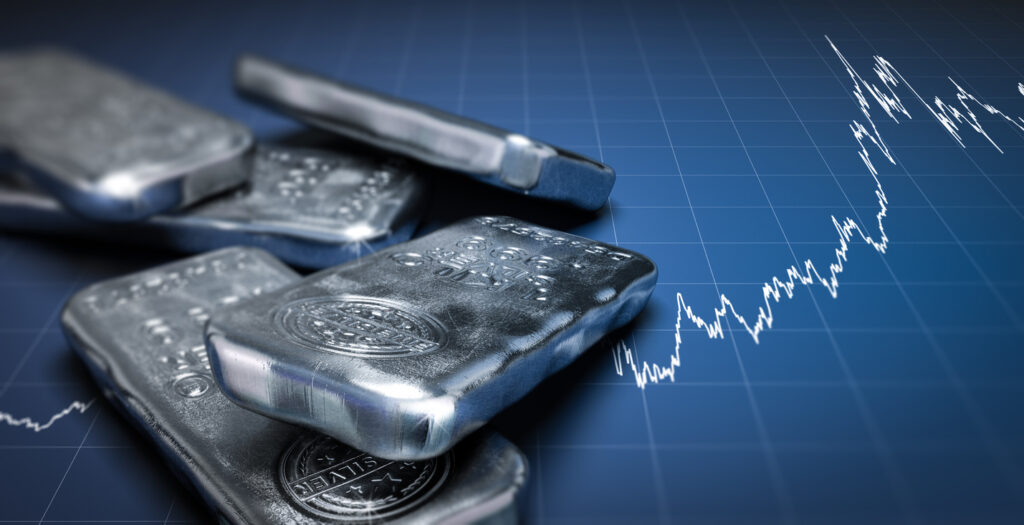
3) How dollar-cost averaging with $40/month works — simple math that builds real ounces – investing in silver
Let’s look at concrete, conservative examples so you can see how $40/month becomes a nest egg over time.
First, a baseline: at $46.80 per troy ounce (a representative mid-Sept 29, 2025 price seen on live feeds), a $40 monthly purchase buys:
- $40 ÷ $46.80 ≈ 0.8547 ounces per month.
That means:
- Over 1 year ($40 × 12 = $480), you’d buy ≈10.256 ounces.
- Over 10 years ($40 × 12 × 10 = $4,800), you’d buy ≈102.564 ounces (if price stayed the same).
- Over 20 years ($9,600 total), you’d buy ≈205.128 ounces.
- Over 30 years ($14,400 total), you’d buy ≈307.692 ounces.
(These “static price” calculations assume the price stays at $46.80 for simplicity — the real world will move — but they show how much physical metal your monthly plan purchases under today’s price.)
The power of compounding (if silver rises) – investing in silver
If silver rises in value over the years, your existing ounces appreciate — so the combination of ongoing buying plus price appreciation multiplies your nest egg. For a clear view, here are hypothetical future-value scenarios for a $40 monthly contribution (not buying miners or ETFs, just the idea of investment growth). We’ll use standard compound growth to illustrate three example average annual returns:
- Conservative: 5% annual average
- Moderate: 10% annual average
- Bull year(s): 20% annual average
Using the standard future-value formula for monthly contributions, a $40/month plan looks like this:
- At 5% annually
- 10 years ≈ $6,211
- 20 years ≈ $16,441
- 30 years ≈ $33,290
- At 10% annually
- 10 years ≈ $8,194
- 20 years ≈ $30,375
- 30 years ≈ $90,420
- At 20% annually (highly optimistic, used here to illustrate upside potential)
- 10 years ≈ $15,044
- 20 years ≈ $124,386
- 30 years ≈ $919,114
These examples illustrate how even small, regular contributions can build surprising wealth if prices appreciate — and how dramatically outcomes differ depending on the annual return. (Reminder: commodities like silver are more volatile than broad stock indexes; a 20% sustained annual return is possible in short bursts but not guaranteed long term. Use this to understand potential, not a promise.)

4) Practical ways to invest $40 / month in silver (and pros / cons) – investing in sivler
If you want to dollar-cost average with $40 per month, here are realistic paths — some available right at Pawn Central, others via financial markets.
A. Buy physical silver coins or rounds (at Pawn Central) – investing in silver
How: Walk into your local Pawn Central (Galesburg, Macomb, Rock Island, IL, or Clinton, IA), and buy silver coins or rounds. With $40 you might buy fractional coins or save for a larger purchase (or combine with a friend/family member).
Pros:
- Tangible metal you hold.
- No counterparty risk.
- Pawn shops often carry a selection of government coins (e.g., 1/10 oz, 1/4 oz) and minted rounds.
Cons:
- Dealer premiums: when buying small amounts, you pay a premium over spot. Premiums are higher on fractional bars and small coins.
- Storage and security: you need a safe or deposit box (some pawn shops offer safe storage options or can advise on secure storage).
- Liquidity: selling back to a dealer may fetch a spread below spot.
Tactics to make $40/month work in physical silver:
- Accumulate cash in a simple envelope and buy when you reach $100–$200 to reduce per-ounce premium.
- Ask Pawn Central about fractional coins they keep in stock so you can buy smaller pieces more frequently.
- Consider trading silver jewelry or older coins — Pawn Central buys silver items, which can offset purchases.
B. Buy silver via dealer buybacks / layaway
How: Some pawn shops and dealers let you put money on layaway for specific coins or sign up for recurring purchases. Ask Pawn Central if they offer recurring purchase programs or can reserve inventory for you.
Pros & Cons: similar to physical buying, but layaway reduces the friction of saving until you hit the amount to buy.
C. Silver ETFs (e.g., SLV) or online platforms – investing in silver
How: Use a brokerage account to buy shares of silver ETFs (which track silver prices) in small dollar amounts. Many brokerages now allow fractional share purchases and automatic monthly investments.
Pros:
- No physical handling or storage costs.
- Lower transaction cost per dollar if using a low-fee broker.
- Easy to set up automated monthly purchases.
Cons:
- ETF management fees (small but present).
- Counterparty/trust structure (not physical allocation in your possession).
- Some ETFs hold futures rather than physical metal — read the prospectus.
D. Silver mining stocks and funds
How: Buy individual silver miner stocks or an ETF of precious-metals miners.
Pros: leverage to higher silver prices; miners can outperform on rallies.
Cons: company-specific risks (management, production), higher volatility.
E. Physical stored programs (allocations)
How: Some dealers and platforms sell allocated physical silver held in vaults on your behalf and allow fractional ownership.
Pros: physical metal without home storage.
Cons: storage fees and ownership terms vary; verify the custodian.
5) A simple, practical plan you can start at Pawn Central today
If you’re a Pawn Central customer and want to build a silver nest egg with $40/month, here’s a step-by-step plan that’s realistic and tailored to how pawn shops operate:
- Set a specific goal. Decide what your $40/month is for — emergency cushion, retirement supplement, or a gift fund. Goals help you stay consistent.
- Open a dedicated “silver” envelope or bank account. Every month, move $40 into that place. If cash is easier, use an envelope; if you prefer digital, set an automatic transfer. Consistency beats timing.
- Buy in batches to reduce premiums. Rather than spending $40 every single week on a tiny fraction with high premium, accumulate until you have $100–$200 and buy a larger fractional coin or 1-oz when possible. Pawn Central can advise which options have the best premiums.
- Ask Pawn Central about fractional coins and rounds they keep in stock. Smaller coins (e.g., 1/10 oz) let you start sooner; rounds usually have lower premiums than minted government coins.
- Consider alternating physical purchases with ETF purchases. For months you can’t get to the shop, make a $40 ETF purchase through a broker; for months you go to Pawn Central, buy physical. That blends liquidity and tangibility.
- Store securely. Keep smaller pieces at home in a hidden safe, or ask about secure storage solutions (bank safe deposit boxes or dealer vaulting options). Pawn Central can discuss local secure storage options.
- Track and review yearly. Reconcile your ounces, total dollars contributed, and check the market once per year. Decide whether to adjust the $40 figure as income allows.
6) Common questions Pawn Central customers ask (answered)
Q: Is it better to buy silver coins or bars?
A: For small monthly amounts, fractional coins (1/10 oz, 1/4 oz) or rounds are practical. Rounds often have lower premiums than government bullion coins. Bars have lower premiums per ounce but require larger lump sums.
Q: How do I avoid scams?
A: Buy from reputable dealers (Pawn Central has a track record locally), ask for assay information, buy government coins or well-known private mints, and insist on a physical inspection. If a deal sounds too good to be true, it often is.
Q: Can Pawn Central buy my old silver jewelry or flatware?
A: Yes — pawn shops buy and appraise silver items. Converting that silver into bullion can be a fast way to start or top off your stack.
Q: How liquid is silver?
A: Silver is highly liquid globally; you can sell to dealers, pawn shops, coin shops, or via online marketplaces. Expect a spread between buy and sell prices.
7) Risks to keep front of mind
- Volatility: Silver can move up and down sharply. That means your account value may swing widely. The same volatility that can boost returns can also produce short-term losses. Bloomberg
- Premiums & fees: Small purchases have higher premiums; storage and ETF fees also reduce net returns.
- Counterparty and custody risk: Physical storage with a third party or ETF holdings involves different risks than holding metal physically yourself.
- No income: Unlike dividend stocks or bonds, silver produces no yield — it’s a price-appreciation play and a hedge.
8) Real customer example (practical illustration)
Meet “Sam” — a Pawn Central customer (fictional example to illustrate the math):
- Sam puts $40 per month into a “silver fund” for 20 years. That’s $480 per year, $9,600 total contributions.
- If Sam simply purchases silver at today’s spot each time (ignoring premiums for the example), that equals ≈205 ounces over 20 years at the September 29, 2025 representative price.
- If the silver price averages a modest 5% annual gain during those 20 years (remember, hypothetical), Sam’s contributions would grow to approximately $16,441 (future value under those assumptions). If silver instead averages 10% per year, that stash could hypothetically be worth ≈$30,375. The key is Sam’s consistent habit — small amounts add up. (See earlier future-value examples.)
9) Why Pawn Central is a smart place to begin this habit-investing in silver
Pawn shops like Pawn Central are often overlooked as starting points for small investors, but they offer key local advantages:
- Immediate access to physical silver (coins, rounds, occasionally bars).
- Appraisal expertise — the staff can help you identify reputable coins and spot counterfeits.
- Buyback potential — when life changes, pawning or selling silver to Pawn Central is often faster and more local than going through online marketplaces.
- Local trust — the stores in Galesburg, Macomb, Rock Island (IL), and Clinton (IA) allow you to build a relationship, ask questions, and learn.
If you’re unsure what to buy, stop by a Pawn Central location and ask to see small fractional coins and rounds, and ask about layaway or persistent buy options. The staff can walk you through the options, premiums, and storage choices.
10) Practical checklist to start tonight
- Commit $40/month (mark it on your calendar or set an auto transfer).
- Save the first three months’ contributions ($120) to reduce per-purchase premium.
- Visit your nearest Pawn Central and ask to view fractional silver coins/rounds in the $100–$200 range.
- Ask about secure storage or recommended safe-deposit box options.
- Consider opening a low-fee brokerage account for an ETF alternative if you want to mix physical and electronic holdings.
- Keep a simple log of dates, dollars, ounces purchased, and price paid — this helps you see your progress.
11) Final thoughts — small habit, big possibilities
You don’t need a huge lump sum to start investing in silver. The key drivers of success are consistency, education, and choice. With a modest $40 per month, you’ll accumulate tangible ounces, learn the rhythms of the market, and build a nest egg that can be used for emergencies, opportunities, or legacy planning.
Right now (September 29, 2025), silver is in the headlines for strong price gains and historic levels in some markets, driven by both macroeconomic and industrial fundamentals. If you’re curious, conservative, and methodical, starting a small monthly program — whether through Pawn Central by buying physical coins or by pairing physical purchases with ETF allocations — is a practical way to gain exposure without betting the farm.
Disclaimer
This blog is educational and intended to explain options and math around small, recurring investments in silver. It is not personalized financial advice. Precious metals are volatile and involve risk. Before making significant investment decisions, consider consulting a licensed financial professional.